Data Sink QDAC (data_sink_qdac)
Provides HDL device worker functionality common to all DAC devices.
data_sink_qdac is an asset in the ocpi.platform.devices component library.
Implementations include the
data_sink_qdac HDL Device Worker (data_sink_qdac.hdl).
Tested platforms include xsim.
Design
The data sink Quad Digital-to-Analog-Converter (QDAC) component provides the properties and ports necessary for its HDL device worker implementation, which provides the functionality that is common to all Digital-to-Analog Converter (DAC) device types. This functionality includes:
Interpreting input messages indicating end of data and finishing on end-of-file (EOF)
Normalizing input data to the bit width of the device
Providing an underrun indicator when the rate of input data is less than the DAC data rate
The data sink QDAC HDL device worker implementation is intended to be paired with
an HDL subdevice worker that translates the dev interface
to a device-specific interface.
A block diagram representation of the implementation is given in Figure 1:
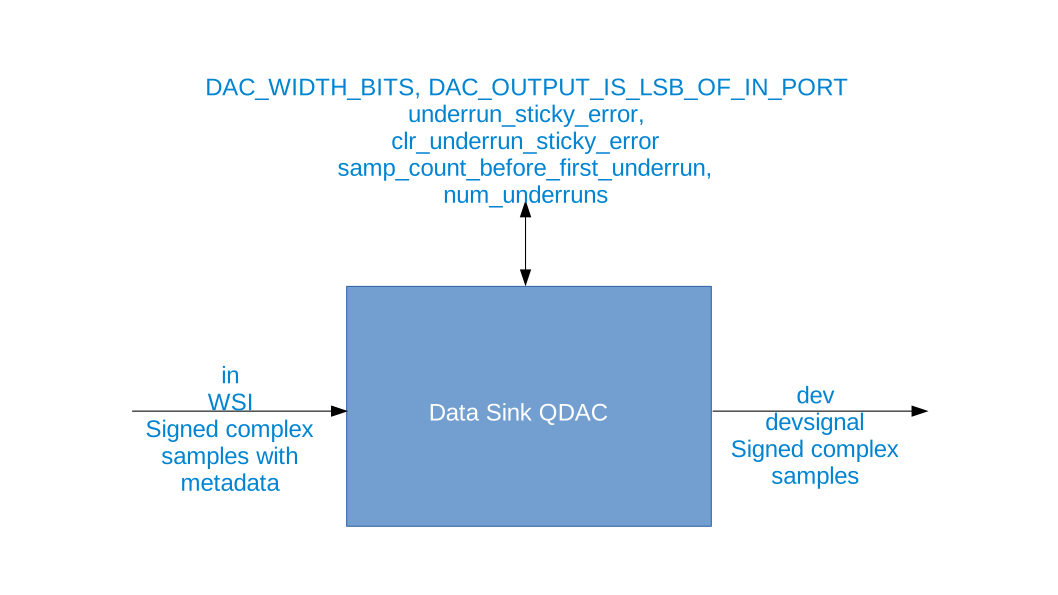
Figure 1: Data Sink QDAC Block Diagram
Interface
<ComponentSpec>
  <Property Name="DAC_WIDTH_BITS"
            Type="UChar"
            Parameter="True"
            Default="12"
            Description="Number of bits in each of the I and Q values delivered to the DAC device"/>
  <Property Name="DAC_OUTPUT_IS_LSB_OF_IN_PORT"
            Type="Bool"
            Parameter="True"
	    Default="false"
            Description="Indicates whether DAC data is extracted from the most
                         significant or least significant DAC_WIDTH_BITS of the in port."/>
  <Property Name="underrun_sticky_error"
            Type="Bool"
            Volatile="true"
            Description="Sticky bit indication of samples underrun."/>
  <Property Name="clr_underrun_sticky_error"
            Type="Bool"
            Writable="true"
            Description="Writing true clears underrun_sticky_error."/>
  <Property name='samp_count_before_first_underrun'
            type='ulong'
            volatile='true'
            description='Number of samples before the first sample underrun.'/>
  <Property name='num_underruns'
            type='ulong'
            volatile='true'
            description='Number of sample underruns.'/>

  <Port Name="in"
        Protocol="ComplexShortWithMetadata-prot"/>
  <Port Name="on_off"
        Protocol="tx_event-prot"
        Optional="1"
        Producer="true"/>
</ComponentSpec>
Properties
DAC_WIDTH_BITS: Number of bits in each of the I and Q values delivered to the DAC device.Type:
ucharAccess:
Parameter:
TrueWritable:
FalseInitial:
FalseVolatile:
False
Default value:
12
DAC_OUTPUT_IS_LSB_OF_IN_PORT: Indicates whether DAC data is extracted from the most significant or least significant DAC_WIDTH_BITS of the in port.Type:
boolAccess:
Parameter:
TrueWritable:
FalseInitial:
FalseVolatile:
False
Default value:
false
underrun_sticky_error: Sticky bit indication of samples underrun.Type:
boolAccess:
Parameter:
FalseWritable:
FalseInitial:
FalseVolatile:
True
Default value:
None
clr_underrun_sticky_error: Writing true clears underrun_sticky_error.Type:
boolAccess:
Parameter:
FalseWritable:
TrueInitial:
FalseVolatile:
False
Default value:
None
samp_count_before_first_underrun: Number of samples before the first sample underrun.Type:
ulongAccess:
Parameter:
FalseWritable:
FalseInitial:
FalseVolatile:
True
Default value:
None
num_underruns: Number of sample underruns.Type:
ulongAccess:
Parameter:
FalseWritable:
FalseInitial:
FalseVolatile:
True
Default value:
None
Ports
Inputs:
inProtocol:
ComplexShortWithMetadata-protOptional:
False
Outputs:
on_offProtocol:
tx_event-protOptional:
True
Implementations
data_sink_qdac(HDL)HDL device worker implementation providing common functionality to all DAC device types.
Example Application
To be supplied: a meaningful example for this HDL device worker.
<?xml version="1.0"?>
<!-- This file is protected by Copyright. Please refer to the COPYRIGHT file
     distributed with this source distribution.

     This file is part of OpenCPI <http://www.opencpi.org>

     OpenCPI is free software: you can redistribute it and/or modify it under
     the terms of the GNU Lesser General Public License as published by the Free
     Software Foundation, either version 3 of the License, or (at your option)
     any later version.

     OpenCPI is distributed in the hope that it will be useful, but WITHOUT ANY
     WARRANTY; without even the implied warranty of MERCHANTABILITY or FITNESS
     FOR A PARTICULAR PURPOSE. See the GNU Lesser General Public License for
     more details.

     You should have received a copy of the GNU Lesser General Public License
     along with this program. If not, see <http://www.gnu.org/licenses/>. -->
<application done="file_write">
  <instance component="ocpi.core.file_read" connect="data_sink_qdac">
    <property name="filename" value="input.bin"/>
  </instance>
  <instance component="ocpi.platform.devices.data_sink_qdac" connect="file_write">
    <!-- Skeleton application outline, set properties here. Or change this
         example application to do something more real-world appropriate if
         file-read, then component, then file-write is too artifical to be a
         useful example. -->
  </instance>
  <instance component="ocpi.core.file_write">
    <property name="filename" value="output.bin"/>
  </instance>
</application>
Dependencies
The dependencies on other elements in OpenCPI are:
None.
Limitations
Limitations of data_sink_qdac are:
None.
Testing
This component test suite uses the OpenCPI unit test framework, which uses a device emulator
worker for verification. The device emulator worker produces clocks of varying frequency
from 1e6 to 200e6 Hz which are forwarded to the dev port of the unit under test.
The unit test checks that the input file and output file
match and that no expected underruns occurred during the test.
Component testing not completed.