drc.rcc RCC Worker
Digital Radio Controller (DRC) for the Xilinx RF Data Converter on the HiTech Global ZRF8 (only the 48DR variant is currently supported).
Detail
The worker’s slave relationships are shown below.

The top-down architecture of the RF Data Converter Architecture using the Digital Radio Controller (DRC) control interface is shown below. The worker is designed around the Xilinx RF Data Converter FPGA IP (v2.5) and the rfdc software library which is added as an OpenCPI prerequisite. This prerequisite exists in the rfdc branch of a fork of opencpi.git at the time of writing this document. The OpenCPI support stack for the RF Data Converter adapts both the RF Data Converter IP and the rfdc software library to use the OpenCPI HDL worker control plane for register access.

A high-level, non-comprehensive C++ class diagram of the worker is shown below.
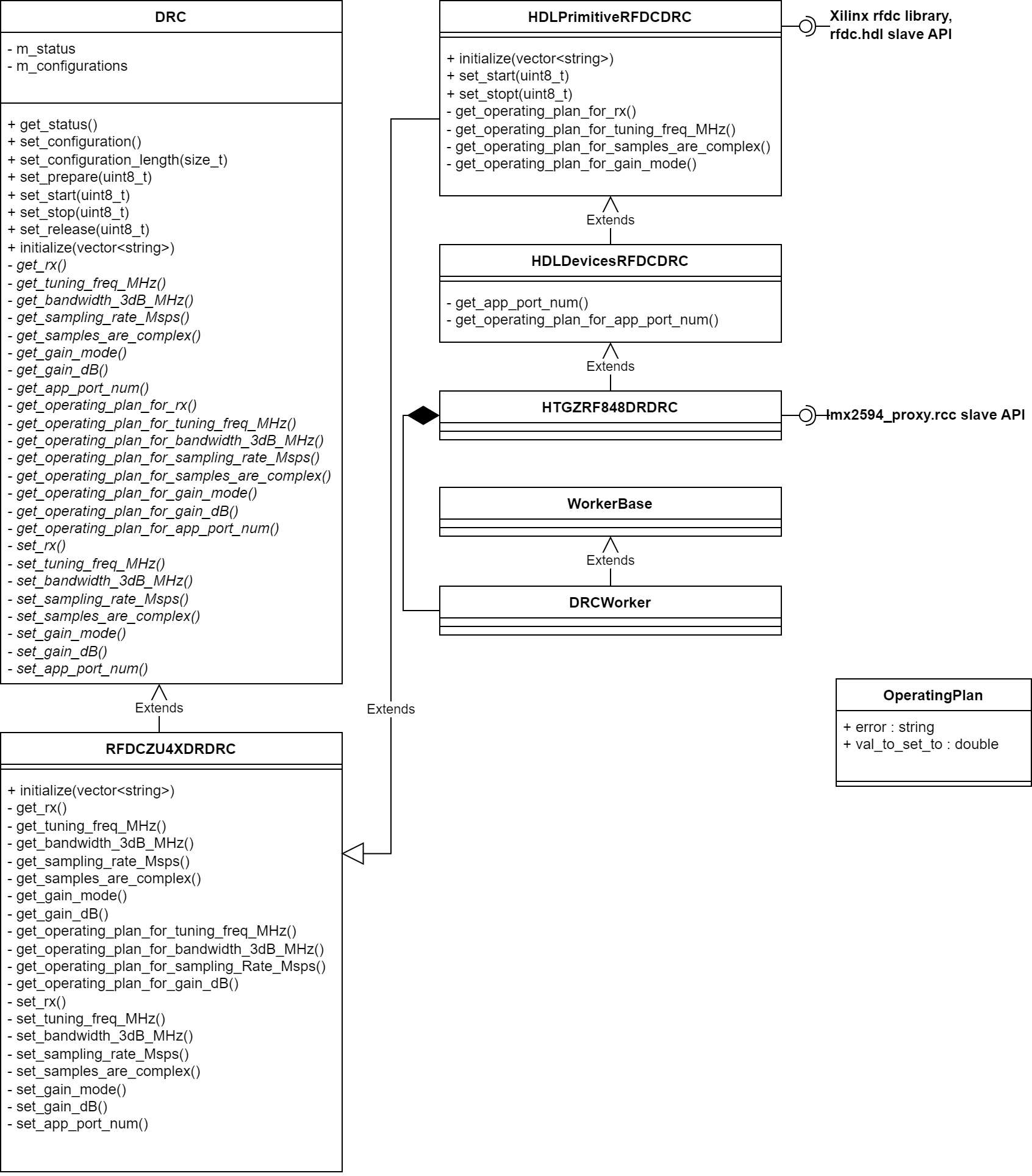
Tested Platforms
xilinx21_1_aarch64 (RCC platform) and zrf8_48dr (platform of the HDL slaves)
Worker Properties
tics_pro_filenameType:
stringAccess:
Parameter:
FalseWritable:
FalseInitial:
TrueVolatile:
FalseRead back:
False
Default value:
""
dump_regsType:
boolAccess:
Parameter:
FalseWritable:
TrueInitial:
FalseVolatile:
FalseRead back:
False
Default value:
false
ocpi_buffer_size_rxType:
ushortAccess:
Parameter:
FalseWritable:
FalseInitial:
TrueVolatile:
FalseRead back:
False
Default value:
0
Worker Ports
txProtocol:
NoneOptional:
True
rxProtocol:
NoneOptional:
True
Inputs:
Outputs:
rfdc and libmetal Software Library Dependencies
The rfdc software library is added as an OpenCPI prerequisite to support runtime configuration and access of the RF Data Converter. The libmetal software library that is built-in (“in-tree”) to the rfdc repo is used. The OpenCPI prerequisite build scripts patch libmetal’s “linux” system to forward libmetal io accesses to callback methods, e.g., get_ushort_prop(), that are later defined in this worker’s DeviceCallback class which has access to the control plane of HDL slave workers. These callback methods are declared in the opencpi repo’s rfdc prerequisite .patch file. The libmetal library has a build dependency on sysfs, which is the usual libmetal method of retrieving buildtime-embedded system information regarding the RF Data Converter. Because OpenCPI has no such paradigm, i.e., OpenCPI FPGA builds will not produce any device tree output that is readable by sysfs at OpenCPI runtime, this worker’s use of the rfdc/libmetal library bypasses sysfs entirely. By not calling the XRFdc_Lookup_Config() API call, as is normally seen in rfdc examples, sysfs is effectively bypassed. These are all critical design details that allow the Xilinx RF Data Converter software and FPGA to interact in the standard OpenCPI fashion.
RF Data Converter Sample Clocking
The HiTech Global ZRF8 uses an LMX2594 device to generate the sampling clock for the RF data converter. The C++ classes herein use lmx2594_proxy.rcc slave to effectively initialize the LMX2594 to have output rates of 3600 MHz for both its outputs, which drive the various ADC/DAC clock inputs of the RF Data Converter FPGA IP. Optionally, users can enter the filename of their own Analog Devices TICS-Pro-generated file via the tics_pro_filename property of this DRC worker, which overrides the default LMX2594 3600 MHz.configuration, but this is not recommended as it could invalidate clock rate assumptions that are hardcoded within the ZRF8DRC-related C++ classes. Note that the RF Data Converter IP instances decimators/interpolators for all interfaces with a factor of 40, so the effective sampling rate exposed to the OpenCPI data plane is 90 Msps. Care is taken to ensure LMX2594 initialization occurs according to the RF Data Converter requirements, especially with respect to RF Data Converter FPGA IP AXI-Lite and AXI-Stream reset ordering. A good indication that the RF Data Converter IP has a good clock configuration and fully completed its Power-On Reset (POR) sequence is the worker runtime logs indicating a POR state (denoted as st in the log below) of 15 for all relevant tiles. The log is in the format “[DEBUG] rfdc <adc/dac> tl<tile#> <config> <value>”:
[INFO] rfdc XRFdc_CfgInitialize
[INFO] rfdc XRFdc_GetIPStatus
[DEBUG] rfdc d tl2 en 1
[DEBUG] rfdc d tl2 st 15
[DEBUG] rfdc d tl2 pu 1
[DEBUG] rfdc d tl2 pl 0
[DEBUG] rfdc d tl3 en 1
[DEBUG] rfdc d tl3 st 15
[DEBUG] rfdc d tl3 pu 1
[DEBUG] rfdc d tl3 pl 0
[DEBUG] rfdc a tl0 en 1
[DEBUG] rfdc a tl0 st 15
[DEBUG] rfdc a tl0 pu 1
[DEBUG] rfdc a tl0 pl 0
[DEBUG] rfdc a tl1 en 1
[DEBUG] rfdc a tl1 st 15
[DEBUG] rfdc a tl1 pu 1
[DEBUG] rfdc a tl1 pl 0
[DEBUG] rfdc a tl2 en 1
[DEBUG] rfdc a tl2 st 15
[DEBUG] rfdc a tl2 pu 1
[DEBUG] rfdc a tl2 pl 0
[DEBUG] rfdc a tl3 en 1
[DEBUG] rfdc a tl3 st 15
[DEBUG] rfdc a tl3 pu 1
[DEBUG] rfdc a tl3 pl 0
RF Port Configuration
The follwing configurations ranges are supported by this DRC worker:
- rf_port_name J18
rx : true
tuning_freq_MHz : [180,405] with step size less than 0.000001 MHz
bandwidth_3dB_MHz : 100
sampling_rate_Msps : 90
gain_dB : [-27,0] with step size of 1 dB
app_port_num : 1
- rf_port_name J3
rx : false
tuning_freq_MHz : [180,855] with step size less than 0.000001 MHz
bandwidth_3dB_MHz : 150
sampling_rate_Msps : 90
gain_dB : 0
app_port_num : 1
- rf_port_name J20
rx : true
tuning_freq_MHz : [180,405] with step size less than 0.000001 MHz
bandwidth_3dB_MHz : 100
sampling_rate_Msps : 90
gain_dB : [-27,0] with step size of 1 dB
app_port_num : 0
- rf_port_name J13
rx : false
tuning_freq_MHz : [180,855] with step size less than 0.000001 MHz
bandwidth_3dB_MHz : 150
sampling_rate_Msps : 90
gain_dB : 0
app_port_num : 0