Negator (negator_l)
Multiplies input values by \(-1\).
Design
Multiplies input values by \(-1\), to change the sign of the values.
The mathematical representation of the implementation is given in (111).
In (111):
\(x[n]\) is the input values.
\(y[n]\) is the output values.
A block diagram representation of the implementation is given in Figure 150:.
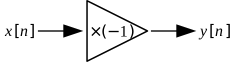
Figure 150: Negator implementation.
Interface
<?xml version="1.0"?>
<componentspec>
  <port name="input" producer="false" protocol="long_timed_sample-prot"/>
  <port name="output" producer="true" protocol="long_timed_sample-prot"/>
</componentspec>
Ports
Inputs:
input: Primary input samples port.Protocol:
long_timed_sample-protOptional:
False
Outputs:
output: Primary output samples port.Protocol:
long_timed_sample-protOptional:
False
Opcode Handling
Only values in a sample opcode message are multiplied by \(-1\). All other opcodes messages received are passed through this component without any effect.
Properties
None.
Implementations
Example Application
<?xml version="1.0"?>
<application done="file_write">
  <instance component="ocpi.core.file_read" connect="negator_l">
    <property name="filename" value="input.bin"/>
  </instance>
  <instance component="ocpi.comp.sdr.math.negator_l" connect="file_write"/>
  <instance component="ocpi.core.file_write">
    <property name="filename" value="output.bin"/>
  </instance>
</application>
Dependencies
The dependencies to other elements in OpenCPI are:
None
There is also a dependency on:
ieee.std_logic_1164
ieee.numeric_std
Limitations
Limitations of negator_l are:
The negation does not handle overflows caused by a full scale negative values being negated
Testing
Tested platforms: None
Component testing not completed.