Triggered Sampler (triggered_sampler)
Implements the core functionality of the triggered_sampler_* HDL workers.
Design
This primitive implements the core functionality of the triggered_sampler_* HDL workers, with the workers providing only a very thin data type conversion layer. Because there is no sample data processing, this single primitive can be used for all protocol variants.
To minimise duplication of logic in the individual workers, this primitive is designed to handle the full OpenCPI streaming data interfaces, and contains logic for handling all opcodes. There is no need for any logic to be implemented in the triggered_sampler workers that use this primitive; they are required only to map the ports and remap the protocol specific opcodes.
Implementation
The structure of the primitive is shown in the following figure, with descriptions for the main blocks below.
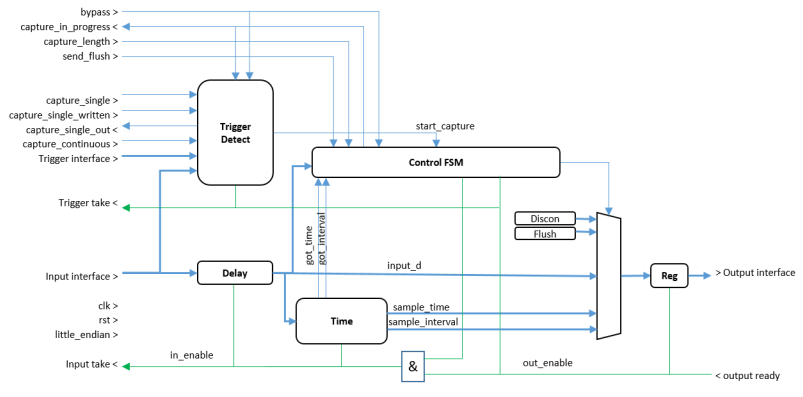
Figure 207: Triggered Sampler Block Diagram
Flow Control
Note that flow of data in all paths is governed by output_ready signal, which is also forwarded to the input and trigger take signals, thus passing on any backpressure to the upstream logic. While the primitive is generating additional time, sample_interval, flush and discontinuity messages associated with each capture, backpressure is applied to the input interface through the take signal.
Trigger Detect
This block is responsible for detecting trigger events on the data and property input and instructing the control FSMs to start a capture operation.
The specific trigger conditions are:
capture_single=true
capture_continuous=trueSOM on trigger interface.
SOM of metadata message on input interface.
If one or more triggers are detected during a capture, this block will ensure another capture is started once the current one is complete.
The logic ensures that when a trigger SOM aligns with an input SOM, the capture begins with that sample.
An EOF on the trigger interface immediately prevents further triggers by that port.
An EOF on the input interface cancels any pending capture and immediately prevents further captures.
Delay
This delays all input messages by one cycle to account for trigger detection logic latency.
Sample Interval
This primitive detects and decodes sample_interval messages on the input, storing the received value for new samples and also forwarding to the output.
Until a sample_interval message is received, the interval is marked as unknown, with got_interval=’0’, to prevent the invalid value being output by the FSM.
Sample Time
This primitive maintains the sample time of the next output sample.
It detects and decodes time messages on the input, initialising the counter to the received value.
Until a time message is received, the sample_time is marked as unknown, with got_time=’0’, to prevent invalid values being output by the FSM.
The sample_time is also marked as unknown on receipt of a discontinuity on the input.
For each input sample, the counter is incremented by “sample_interval”, but if the sample_interval is unknown at that point, the sample_time counter is marked as unknown.
Control FSM
This controls the capture process, generation of new capture framing messages and forwarding of messages from input to output.
It monitors the capture_start signal and input_d (delayed) input.
It has the following state flow:
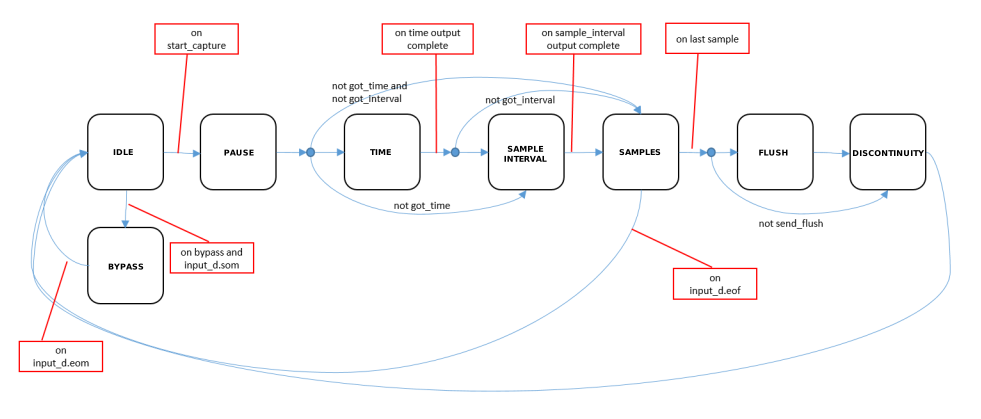
Figure 208: Triggered Sampler FSM State Flow
The actions performed in each state are:
IDLE
On EOF in,
Forwards EOF to output.
In bypass,
Forwards all messages to output.
Go to BYPASS state for non-zero length messages.
In non-bypass,
Forwards metadata and flush messages.
On start_capture, go to PAUSE.
BYPASS
Finish forwarding the current message.
Return to IDLE on EOF.
This state ensures whole messages are forwarded in the case that bypass is de-asserted part way through a message.
PAUSE
Single cycle pause to allow sample_time to update to complete.
Nothing is written to output.
Advance to TIME, SAMPLE INTERVAL or SAMPLES (depending on whether time and interval are known).
TIME
Shift out the current sample_time value over one or more cycles (depending on bus width) to generate a time message.
When complete, advance to SAMPLE INTERVAL or SAMPLES (depending on whether interval is known).
SAMPLE INTERVAL
Shift out the current sample_time value over one or more cycles (depending on bus width) to generate a sample_interval message.
When complete, go to SAMPLES.
SAMPLES
On EOF in,
Forwards EOF to output.
Abort capture (since no more samples are coming) and Go to IDLE.
On bypass,
Forward any message to output.
On EOM, return to IDLE.
Otherwise,
Forward all messages to output.
Count the number of samples forwarded.
Once the required capture_length has been reached, go to FLUSH or DISCONTINUITY, depending on the state of the send_flush property.
FLUSH
Write single work zero-length flush message to output.
Go to DISCONTINUITY.
DISCONTINUITY
Write single work zero-length discontinuity message to output.
Return to IDLE.
The in_enable signal is forced low while the FSM is in PAUSE, TIME, SAMPLE INTERVAL, FLUSH or DISCONTINUITY state, and is therefore unable to process (pass-on or discard) input messages.
Interface
Types
This type is defined in the sdr_util_pkg package:
opcode_t(enum): For passing opcodes to/from the primitive.
sample_op_e
time_op_e
sample_interval_op_e
flush_op_e
discontinuity_op_e
metadata_op_e
Workers will need to translate between their specific opcode type and this generic primitive type.
Generics
data_width_g(positive): Width of the data input and output signals.
capture_length_width_g(positive): Width of the capture_length property.
little_endian_g(boolean): Defines input/output message word order.
Ports
Control signals
clk(std_logic), in: Single clock.
rst(std_logic), in: Reset. Active high, synchronous with rising edge ofclk.Properties
bypass(std_logic), in:
capture_length(unsigned, capture_length_width_g bits), in:
send_flush(std_logic), in:
capture_on_meta(std_logic), in:
capture_single_in(std_logic), in:
capture_single_written(std_logic), in:
capture_single_out(std_logic), out:
capture_continuous(std_logic), in:
capture_in_progress_out(std_logic), out:Trigger input stream. Uses the standard OpenCPI streaming data interface.
trigger_som(std_logic), in:
trigger_ready(std_logic), in:
trigger_take(std_logic), out:Sample data input stream. Uses the standard OpenCPI streaming data interface.
input_data(std_logic_vector, data_width_g bits), in:
input_opcode(opcode_t), in:
input_som(std_logic), in:
input_eom(std_logic), in:
input_eof(std_logic), in:
input_valid(std_logic), in:
input_ready(std_logic), in:
input_take(std_logic), out:Sample data output stream. Uses the standard OpenCPI streaming data interface.
output_data(std_logic_vector, data_width_g bits), out:
output_opcode(opcode_t), out:
output_som(std_logic), out:
output_eom(std_logic), out:
output_eof(std_logic), out:
output_valid(std_logic), out:
output_give(std_logic), out:
output_ready(std_logic), in:
Dependencies
The dependencies to other elements in OpenCPI are:
None.
There is also a dependency on:
ieee.std_logic_1164
ieee.numeric_std
ieee.math_real
Limitations
Limitations of triggered_sampler are:
Supports version 2 interfaces only.
Only tested in little endian configuration.