Carrier Mixer (carrier_mixer_xs)
Multiplies the input with a complex carrier wave.
Design
Mixes a complex input with a carrier wave generated by the component.
The mathematical representation of the implementation is given in (7) and (8).
\(x[n]\) is the input values.
\(y[n]\) is the output values.
\(\delta[m]\) is the mixer step size values from the instep port. \(n\) is zero then the instep delta sum will be from zero to \(-1\), in this case this sum is zero.
\(A\) is the amplitude of the mixer wave, equal to 1.646760258 *
carrier_amplitudeproperty. The 1.646760258 scaling is a result of the gain of the CORDIC algorithm used in the DDS implementation of the carrier generator.
If carrier_amplitude is set too large an overflow will occur. As the scaling is a bit mapping an overflow of this signed value will lead to unstable output. To prevent overflow carrier_amplitude must not be set above 14,060. To prevent overflow (9) must hold for the real values, an equivalent expression exists for imaginary values.
In (9), * \(x + jy\) is an input complex sample value. The maximum value \(A\), and so carrier_amplitude, can take occurs when the condition (9) is an equality. Maximisation of the left-hand side of (9) occurs when \(x=x_{max}\), \(y=-x_{max}\), and the input phase maximises \(\cos{\theta} + \sin{\theta}\) which has a maximum of \(\sqrt{2}\). This results in (10).
As the carrier_amplitude property is scaled by 1.646760258, the limit to carrier_amplitude is \(23170.475... / 1.646760258 = 14070.33...\). As the carrier generator uses an approximation an empirically determined margin is need for the theoretical maximum to give a tested and supported maximum of 14,060.
\(\delta[m]\) must have an input value for each value on \(x[n]\). Therefore, for a fixed frequency carrier to be multiplied by the input \(x[n]\), then \(\delta[m]\) must have a constant input of the same value.
A block diagram representation of the implementation is given in Figure 71:.
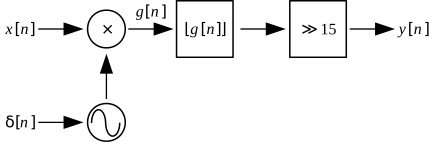
Figure 71: Block diagram of carrier mixer implementation.
The relation between the output frequency shift and \(\delta[n]\) values is given by (11).
In (7):
\(f\) is the desired frequency shift.
\(F_s\) is the sample rate of the system.
Interface
<?xml version="1.0"?>
<componentspec>
  <property name="instep_opcode_passthrough" type="bool" writable="false" parameter="true" default="false"
    description="When true opcodes from the instep port are passed to the output, when false opcodes from the input port are passed
      to the output."/>
  <property name="carrier_amplitude" type="ushort" writable="true" default="14060"
    description="Amplitude of the carrier mixed with the input signal. Set to :math:`\left \lfloor
      \frac{\text{desired_maximum}}{1.646760258} \right \rfloor`."/>
  <port name="input" producer="false" protocol="complex_short_timed_sample-prot"/>
  <port name="instep" producer="false" protocol="long_timed_sample-prot"/>
  <port name="output" producer="true" protocol="complex_short_timed_sample-prot"/>
</componentspec>
Ports
Inputs:
input: Primary input samples port.Protocol:
complex_short_timed_sample-protOptional:
False
instep: Mixer step size.Protocol:
long_timed_sample-protOptional:
False
Outputs:
output: Primary output samples port.Protocol:
complex_short_timed_sample-protOptional:
False
Opcode Handling
Only values in a sample opcode messages are multiplied together.
Non-sample opcodes from a single input are forwarded onto the output interface. The instep_opcode_passthrough parameter selects which input interface is used for non-sample opcode forwarding. Non-sample opcodes on the other input to what instep_opcode_passthrough is set to are discarded.
Properties
instep_opcode_passthrough: When true opcodes from the instep port are passed to the output, when false opcodes from the input port are passed to the output.Type:
boolAccess:
Parameter:
TrueWritable:
FalseInitial:
FalseVolatile:
False
Default value:
false
carrier_amplitude: Amplitude of the carrier mixed with the input signal. Set to \(\left \lfloor \frac{\text{desired_maximum}}{1.646760258} \right \rfloor\). This should not be set to greater than 14,060 - this value maps to near full range output on a 16-bit signed value.Type:
ushortAccess:
Parameter:
FalseWritable:
TrueInitial:
FalseVolatile:
False
Default value:
14060
Implementations
Example Application
<?xml version="1.0"?>
<application done="file_write">
  <instance component="ocpi.core.file_read" connect="carrier_mixer_xs" to="input">
    <property name="filename" value="input.bin"/>
  </instance>
  <instance component="ocpi.core.file_read" connect="carrier_mixer_cs_cs" to="instep">
    <property name="filename" value="instep.bin"/>
  </instance>
  <instance component="ocpi.comp.sdr.dsp.carrier_mixer_xs" connect="file_write">
    <property name="carrier_amplitude" value="14060"/>
  </instance>
  <instance component="ocpi.core.file_write">
    <property name="filename" value="output.bin"/>
  </instance>
</application>
Dependencies
The dependencies to other elements in OpenCPI are:
There is also a dependency on:
ieee.std_logic_1164
ieee.numeric_std
ieee.math_real
Limitations
Limitations of carrier_mixer_xs are:
Setting of
carrier_amplitudeabove 14,060 is untested behaviour and will result in unpredictable behaviour.
Testing
Tested platforms: None
Component testing not completed.