Serial CRC Generator (crc_serial)
Cyclic Redundancy Check (CRC) generator.
Design
A CRC is an error-detecting algorithm commonly used to detect errors during the exchange of data.
The CRC value is the remainder of a polynomial division algorithm on the input data stream. The CRC calculation (modulo 2 divisions) can be easily performed by logical combinations of shift registers and XOR gates.
The linear feedback shift register (LFSR) is the most common approach for a serial CRC generator implementation. The specific LFSR type this design uses is called Galois.
Figure 186: shows an example serial CRC generator with a polynomial of \(x^5 + x^2 + 1\) (0x5) as is used for the USB 2.0 protocol.
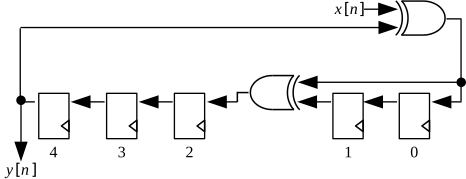
Figure 186: Example serial CRC generator. With polynomial \(x^5 + x^2 + 1\). \(x[n]\) are the input values. \(y[n]\) are the output values.
Implementation
The polynomial sets the divisor of the polynomial long division algorithm. The order of the polynomial sets the number of shift registers required to implement the LFSR. The polynomial is defined at build time using the generic polynomial_g.
The initial CRC output can be set during run time using the seed input. When the reset signal, rst, is set high the CRC output becomes the value of seed on the next rising clock edge.
Depending on the application the CRC result may need to be reflected. Generic output_reflect_g provides the option to enable or disable this at build time.
Some applications require a final XOR on the CRC result. The final XOR value can be set during run time using the final_xor input.
This implementation can generate a new output every clock cycle. There is a one clock cycle latency before the CRC result is available after a valid input. A clock enable input, clk_en, is provided to control when an input is valid and therefore shifted into the LFSR. The CRC generator state will not advance when the clock enable is low.
Interface
Generics
polynomial_g(std_logic_vector): Polynomial value.
output_reflect_g(std_logic): Enable / disable output CRC reflection.
Ports
clk(std_logic), in: Clock. Inputs and outputs registered on rising edge.
rst(std_logic), in: Reset. Active high, synchronous with rising edge of clock.
clk_en(std_logic), in: Enable. Enables / disables data input when high.
data_in(std_logic), in: Data input. Binary input data.
seed(std_logic_vector,polynomial_g'lengthbits), in: Seed. Initial CRC value.
final_xor(std_logic_vector,polynomial_g'lengthbits), in: Final XOR. Value to XOR CRC result with.
crc_out(std_logic_vector,polynomial_g'lengthbits), out: CRC. Available after one clock cycle delay.
Dependencies
The dependencies to other elements in OpenCPI are:
None.
There is also a dependency on:
ieee.std_logic_1164
Limitations
Limitations of crc_serial are:
Although less resources are utilised than
crc_parallel’s design the throughput is less as it only allows the CRC calculation of one data bit every clock cycle.